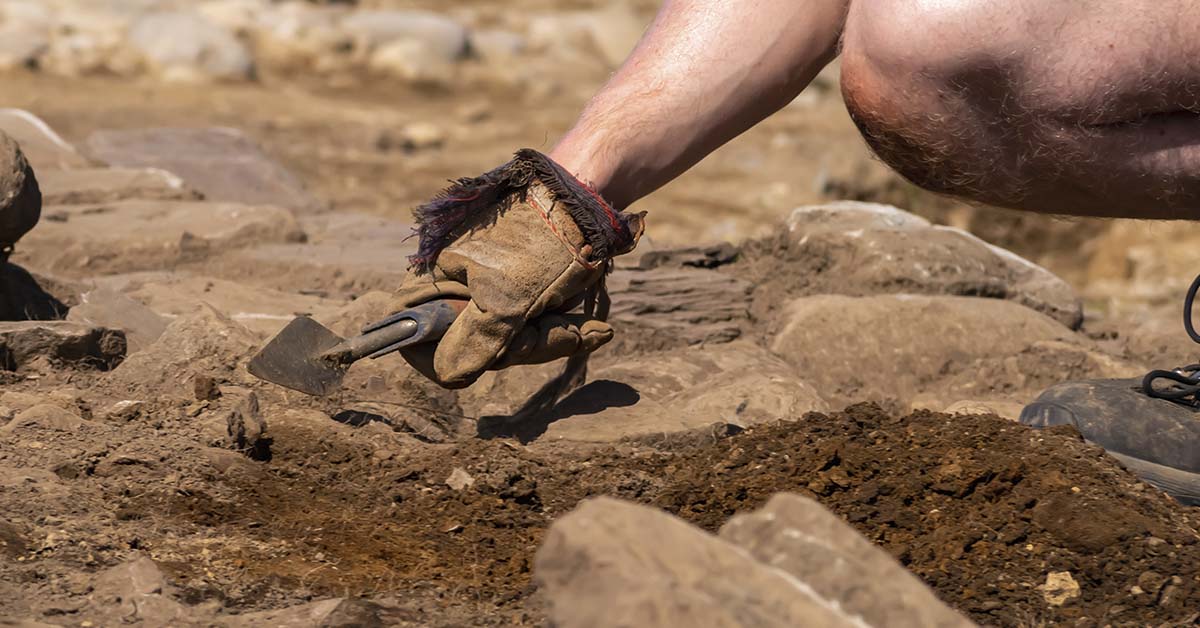

In the small town of Nördlingen, situated in Bavaria, an astounding artifact was found.1 A 3,000-year-old octagonal sword belonging to the Bronze Age that continues to shimmer even after three thousand years, has created a wave of excitement. This exceptional artifact, steeped in mystery and beauty, was discovered within a grave holding the remnants of a man, woman, and child. Their relationship is yet to be ascertained, but the nature of their burial hints at a shared destiny, as reported by the Bavarian State Office for Monument Protection.
Skilled Craftsmanship
What makes this sword stand out among historical relics is its astonishing preservation. In the words of the Bavarian State Office for Monument Protection, the sword “almost still shines.” The octagonal hilt, a work of art in itself, was made from bronze and has turned green over centuries due to the oxidation process that copper, a constituent of bronze, undergoes when exposed to air and water.
This sword is not just a weapon; it’s a historical document dating back to the 14th century B.C., a timeline when grave robbing was rampant, leading to a scarcity of intact artifacts from this period. This context discovers this exceptionally well-preserved sword an exceptionally rare event, shedding light on an era long past.
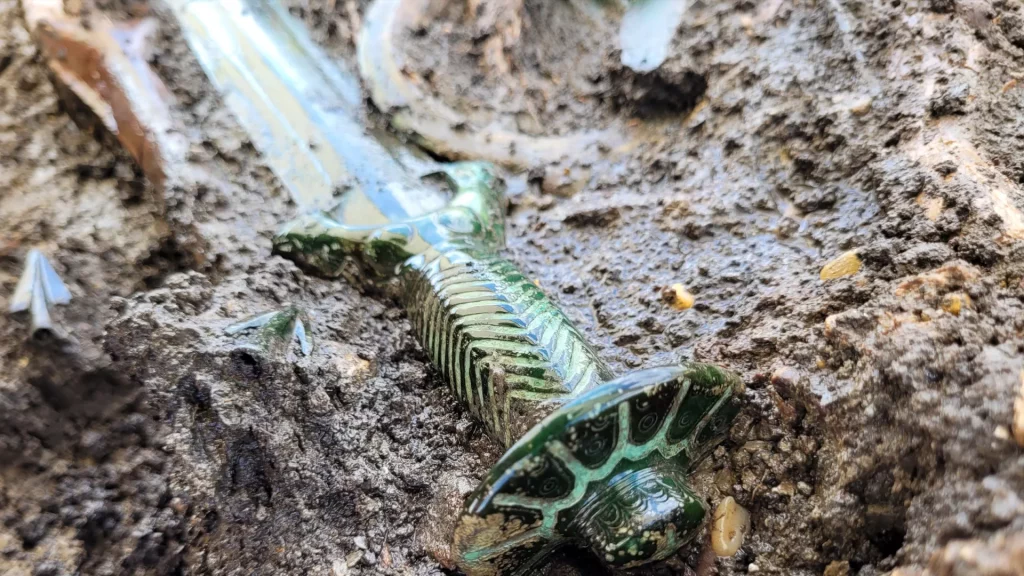
The complex craftsmanship behind the creation of an octagonal sword is a testament to the sophistication and skill of the Bronze Age blacksmiths. The handle of the sword, enhanced with two actual rivets, was cast over the blade in a method known as overlay casting. Strangely, the blade is devoid of any visible signs of wear or cut marks, leading to the theory that the sword might have been used for ceremonial or symbolic purposes. Despite these assumptions, the sword’s construction, and specifically the center of gravity located at the blade’s front end, suggests it could have been used effectively in combat, capable of dealing deadly slashing blows.
Read: Girl, 8, pulled a 1500-year-old sword from a lake in Sweden
Octagonal Swords: A Legacy of Mastery
The Achtkantschwert, or the octagonal sword, is a marvel of ancient blacksmithing, requiring not only the precise casting but also intricate decoration. Such a creation could only be the work of the most accomplished smiths of that era.2 Historical records indicate two key manufacturing areas for these swords, one in southern Germany and another spanning northern Germany and Denmark. Yet, despite these clues, the precise origins of the recently discovered sword remain elusive.
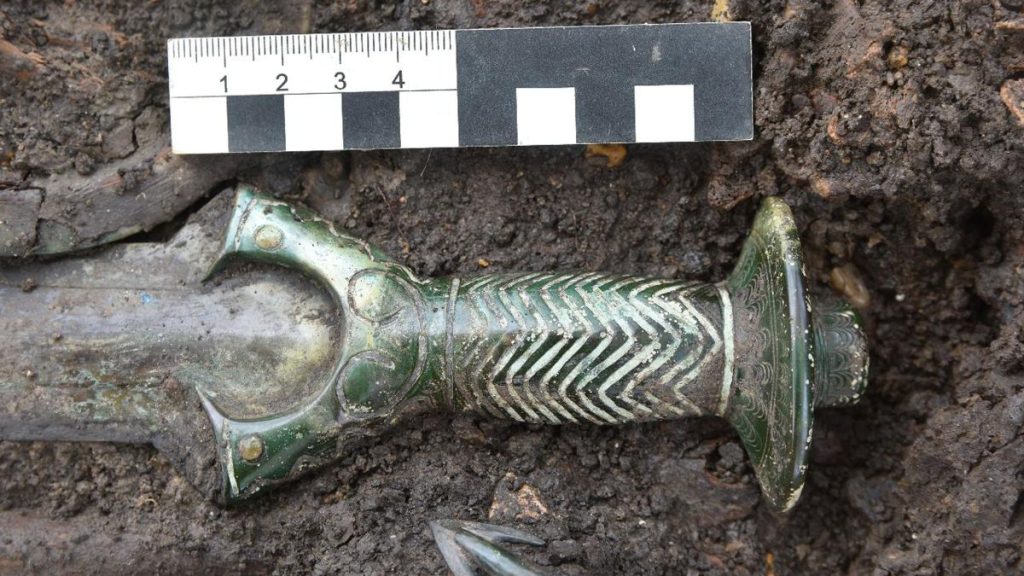
The Bavarian State Office for Monument Protection’s statement gives a glimpse into the complexities of producing an octagonal sword, explaining, “The production of octagonal swords is complex because the handle is cast over the blade (so-called overlay casting). The decoration is made with an inlay and using hallmarks. While there are two real rivets, another pair of rivets are only implied.” This fascinating blend of art and craft, embodied in the discovered sword, speaks volumes about the technological prowess of its unknown creators.
An Unraveled Bronze Mystery
The burial site housing the remains of a man, woman, and child raises many questions. As the Bavarian State Office for Monument Protection stated, “It is not yet clear whether the persons were related or what the relationship between them was.” Despite these uncertainties, the discovery of the sword has sparked immense interest and excitement, not just among archaeologists but across Germany and beyond.
Mathias Pfeil, the head of the Bavarian State Office for the Preservation of Monuments, expressed eagerness for further investigations. He said, “The sword and the burial still have to be examined further so that our archaeologists can classify this find more precisely.” However, he has already praised the extraordinary condition of the artifact, declaring, “But it can already be said that its condition is exceptional. A find like this is very rare!”

This sword’s unearthing is especially unique given the historical context. Most burial mounds in this German region were victims of looting, and it’s exceptionally rare to find intact artifacts. The rarity of such swords from this period, coupled with the exceptional condition of the discovered piece, makes it an invaluable find, irrespective of whether it served as a ceremonial object or a practical weapon. The road ahead for this ancient sword is filled with thorough research and detailed analysis, which will hopefully unlock more secrets of the Bronze Age and shed light on the lives and skills of our ancestors.
Keep Reading: Amateurs discovered an ancient grave that rewrites history
Sources
- “‘Octagonal’ sword from Bronze Age burial in Germany is so well preserved it shines.” Live Science. Laura Geggel. June 2023.
- “Archaeologists Discover Exceptionally Well-Preserved 3,000-Year-Old Sword.” Newsweek. Jess Thomson. June 16, 2023.