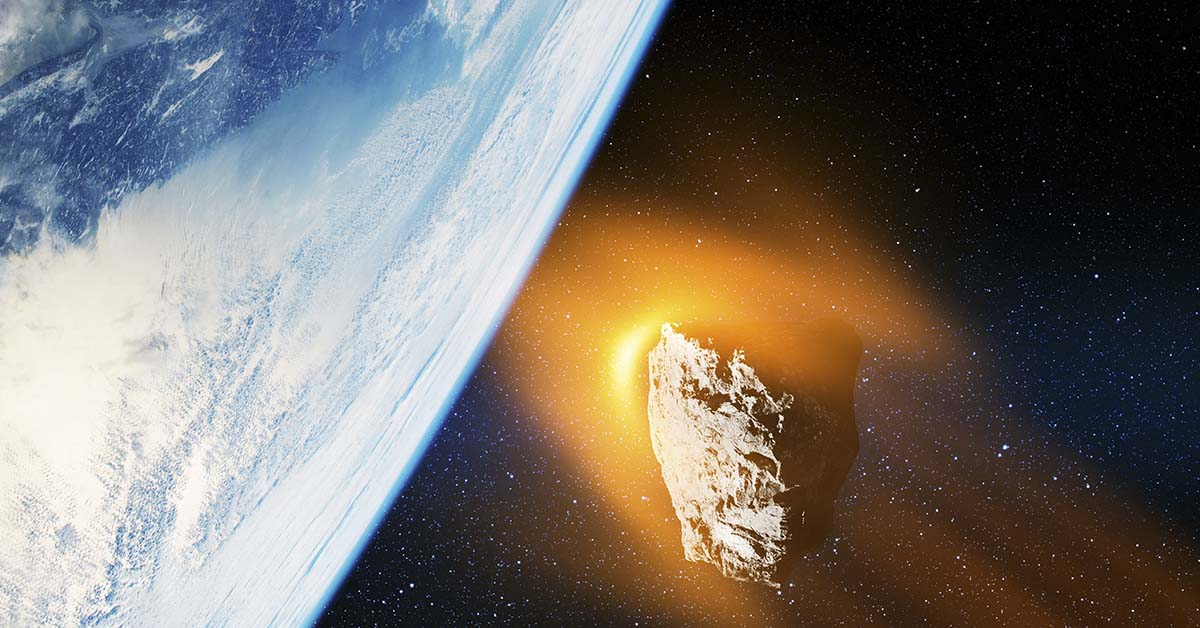

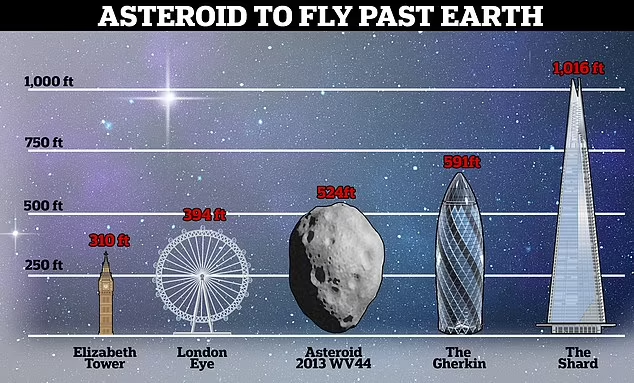
This week couldn’t get any worse. A huge asteroid, bigger than the London Eye, is expected to make its way through the Earth’s orbit. The celestial object, known as Asteroid 2013 WV44, zoomed by around 9 am on Wednesday, June 28. Hurtling at an estimated speed of 26,000 miles per hour. It will be moving at roughly 34 times the speed of sound.
Measuring about 525 feet in width, this celestial object will reach its closest point to Earth at a distance of a million miles. While this may seem like quite a distance , it’s close enough to meet the criteria for a “Close Approach.” Based on the experts at NASA.
The asteroid, larger than the London Eye by 98 feet, is categorized as a “Near Earth Object (NEO).” However, there is an extremely low risk of it causing any damage due to its significant distance from Earth. While the exact visibility locations of the asteroid remain unknown, it’s worth noting that watching most NEOs usually requires specialized equipment from Earth.
There are loads of near-Earth objects or “NEOs”– more than 31,000 detected to date
According to Dr. Susanna Kohler from the American Astronomical Society, asteroids do not emit visible light alone. Instead, we actually observe them by the sunlight they reflect. The asteroid known as 2013 WV44 is just one among more than 31,000 near-Earth objects (NEOs) that have been detected thus far, with the possibility of many more on the verge of discovery in the vast expanse of space.
The classification of NEOs involves considering how close they are to Earth’s orbit. Any asteroid that comes within 30 million miles of Earth’s orbit falls into this category. NASA designates them as “potentially hazardous objects” if they approach within 4.6 million miles of Earth’s orbit. They also have to have a diameter larger than 460 feet.
Read: NASA Is Tracking a Vast, Growing Anomaly in Earth’s Magnetic Field
There are no disasters suspected at this stage, but there are quite a few asteroids on the ‘potentially hazardous’ list
To date, roughly 2,300 asteroids have been included in the “potentially hazardous” list. While none of these asteroids pose an immediate threat of disaster, there is always a risk that their orbits could be altered. Thus potentially putting them on a collision course with Earth. These asteroids are actually pieces of larger rock, often referred to as “cosmic leftovers,” from the formation of the solar system roughly 4.5 billion years ago.
During the early stages of Jupiter’s formation, the process involved numerous collisions between smaller celestial bodies. These collisions caused fragmentation and the creation of fragments or smaller objects in the area.
2013 WV44 poses no real harm, but we will be extremely close for a short period of time
The distance between Earth and the Moon is nearly 19 times greater than the estimated distance of asteroid WV44. Considering this significant gap, it is safe to assume that despite its size, the asteroid WV44 does not pose any harm or immediate threat to our planet.
NASA has been tracking potential risks from asteroids and the like for the last 100 years
Nasa has been monitoring the trajectories of all near-Earth objects well into the future. So far, the outlook shows that Earth is not at significant risk for at least the next century. In the event that a space object does come rather close, Nasa has plans in place to address the situation.
In a notable achievement last year, Nasa successfully redirected the orbit of a small asteroid by intentionally crashing a spacecraft into it. This ground-breaking event marked the first deliberate alteration of a celestial object’s motion. It also served as a full-scale display of asteroid deflection technology.
This accomplishment provides confidence that a similar method can be employed if an asteroid deemed “earth-threatening” appears to be on a collision course with our planet. Nasa’s preparedness ensures that protective measures can be taken to safeguard humanity in such a scenario. You can track these beautiful out-of-this-world objects here. You can even track 2013 WV44 here.
Keep Reading: NASA spacecraft spots eerie green light on Jupiter
Sources
- “Huge 160m asteroid ‘bigger than London Eye’ set to crash through Earth’s orbit in days.” Daily Star UK. Kelly Williams. June 26, 2023.
- “Asteroid ‘bigger than the London Eye’ hurtling towards Earth.” Metro. Anugraha Sundaravelu. June 26, 2023