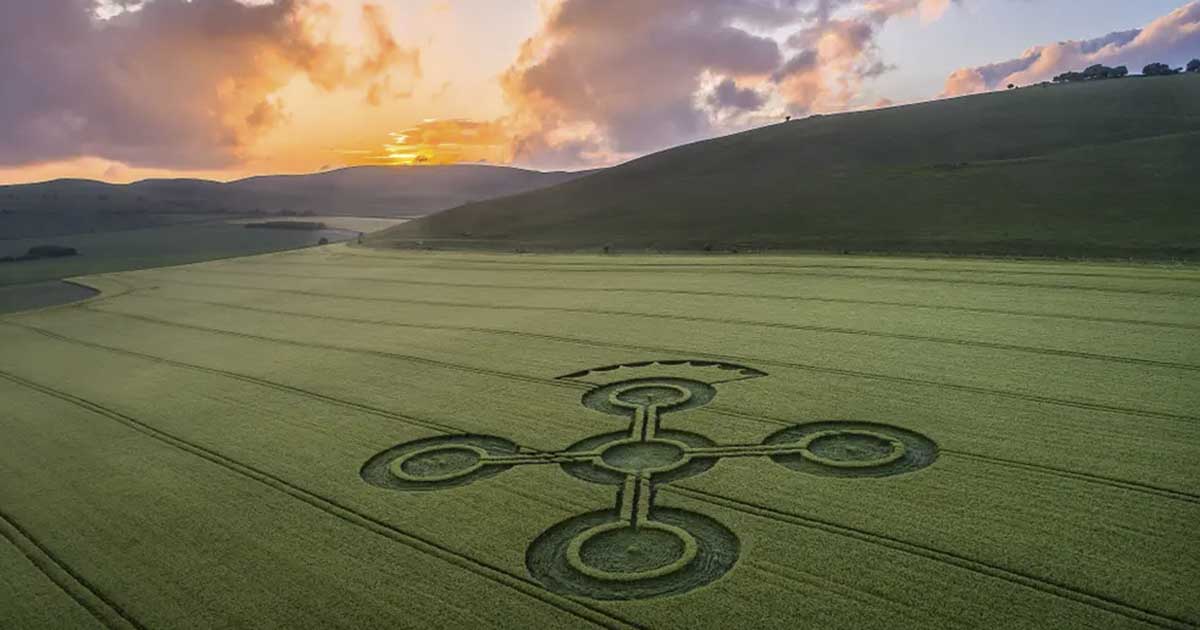

Crop circles were once a popular topic in the late 1990s and early 2000s, seen as proof of extraterrestrial activity and featured in various media outlets. However, these patterns aren’t the mysteries we believed them to be.
Hundreds of years ago, mysterious markings started appearing in fields, sometimes attributed to supernatural forces or cyclonic winds. But it wasn’t until the mid-20th century that these circles started getting more attention. Often associated with UFOs and extraterrestrial landings, reports from all over the world linked these patterns to answers beyond the stars.
Emergence of Hoaxes
A pivotal moment came in 1976 when two Englishmen, Doug Bower and Dave Chorley, decided to create their own crop circles near Hampshire and Wiltshire. Using simple tools like planks and ropes, they were responsible for over 200 different crop patterns, bringing much attention to their deceptive creations. But in 1991 they fessed up and, confirmed by investigations, exposed the human origins of the seemingly mysterious circles.
Despite the revelation of their hoax, some believers refused to accept the truth. However, crop circles gradually lost their credibility as evidence of alien visitors ad they seemed to fade into obscurity. The allure waned once people realized that the patterns were creative human projects, and not alien in origin. The thrill of a potential connection to extraterrestrial life diminished, leaving these circles as mere artistic expressions.
Read: Someone Notices First Steps On The Moon Don’t Match Neil Armstrong’s Boots, Gets Destroyed With Facts
The Legacy of Crop Circles
Curiously, despite evidence revealing their true nature, some people have continued to cling to their beliefs in extraterrestrial involvement. This persistence in denying the undeniable has contributed to perpetuating a sense of mystery surrounding crop circles, creating a divide between skeptics and believers. This persistence can also be seen in flat earth theory.
Presently, crop circles continue to be created, but as (often very beautiful) works of art, displaying thorough and intricate designs and creativity. The legacy of these circles lies in their evolution from a mystery shrouded in speculation to recognized pieces of landscape art. But while the mystery behind their origin has been solved, a segment of enthusiasts remains steadfast in their refusal to acknowledge the truth.
Crop Circles’ Impact
The phenomenon of crop circles not only sparked interest but also highlighted the human tendency to indulge in and perpetuate mysteries, even in the face of evidence. The shift from a mystical phenomenon to an acknowledged human-made creation showcases the power of perception and belief.
Crop circles, once symbols of intrigue and debate, have left a legacy. Their evolution from a mysterious enigma to known human creations highlights the complexity of belief systems and our innate curiosity for the unexplained. While the allure of crop circles has subsided, their legacy remains a testament to our fascination with the unknown and the complexities of human beliefs and perceptions.
Keep Reading: Seventeen “Conspiracy Theories” That Turned Out To Be Completely True